

As the political landscape in Dhaka undergoes a seismic shift following the BNP’s return to power, major global players, particularly India and the United States, are moving swiftly to recalibrate their relationships with the administration led by Prime Minister Tarique Rahman.
Recent diplomatic activities, marked by high-level meetings and an upcoming ministerial visit to New Delhi, indicate a shift from cautious observation to active engagement.
On Monday (April 6), the state news agency BSS reported that Bangladesh will raise key bilateral concerns, including extradition, trade, water sharing, and border security, during the Foreign Minister’s upcoming visit to India.
Foreign Minister Dr. Khalilur Rahman will depart for New Delhi on Tuesday for what Dhaka describes as a “goodwill visit,” marking the first such visit by a Bangladeshi minister since the new government assumed office.
According to BSS, this trip involves substantive engagements to advance a “Bangladesh first” approach. Dhaka plans to reiterate its request for the extradition of deposed prime minister Sheikh Hasina and others in connection with specific legal cases.
Acknowledging that legal procedures take time, Dhaka is prioritizing steady judicial cooperation while simultaneously pushing for a resolution on the Teesta water-sharing issue and the renewal of the Ganges Treaty before its year-end expiration.
Indian media outlets have recently noted New Delhi’s pragmatic need to engage with the new leadership in Dhaka to protect regional security and connectivity interests. Reflecting a move toward regional recalibration, Indian High Commissioner Pranay Verma’s courtesy call on Prime Minister Tarique Rahman on April 6 served as a high-profile step in bridging ties between the two neighbors.
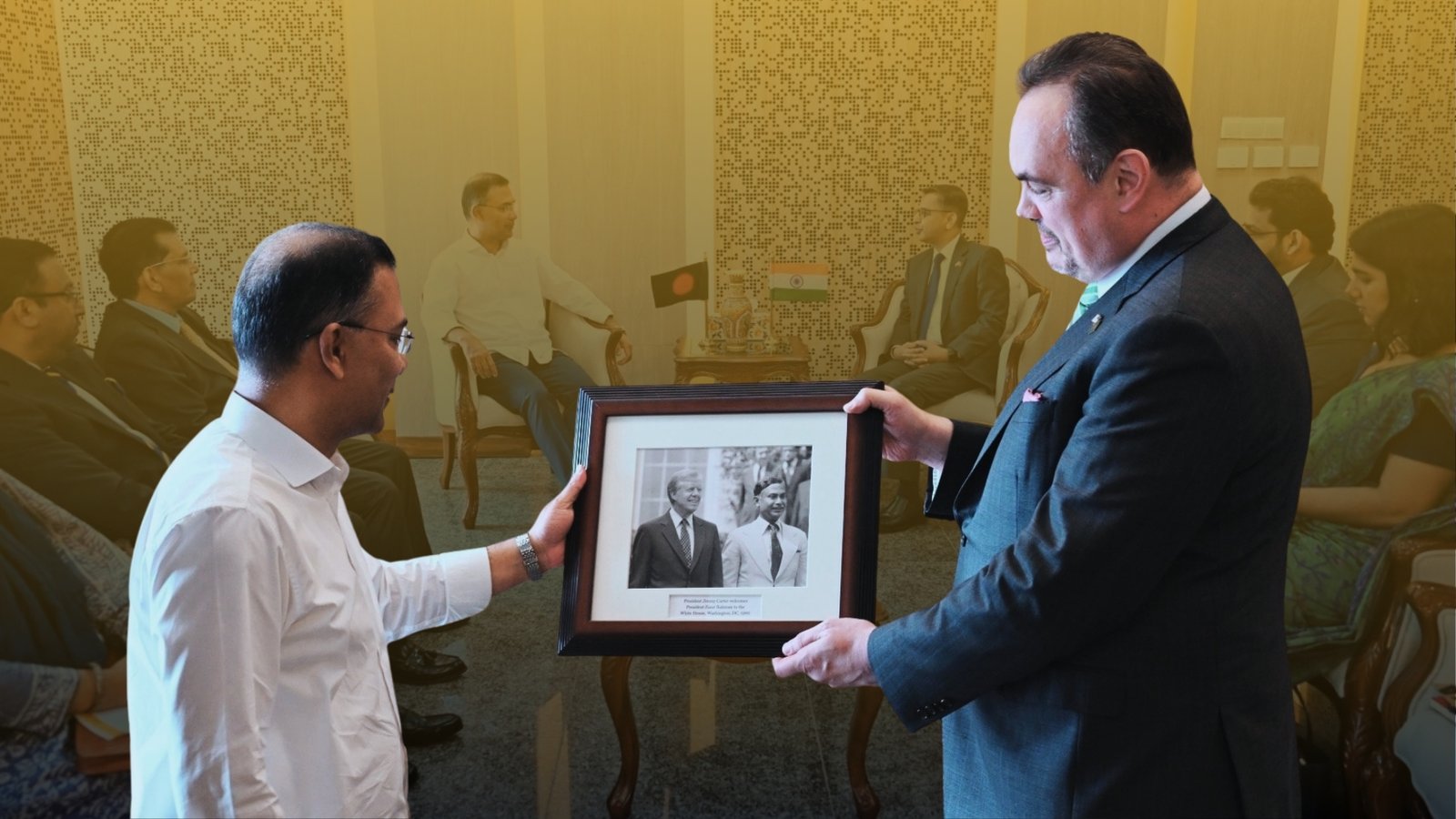
Simultaneously, the United States has signaled its interest through both symbolic gestures and substantive policy discussions. On Sunday (April 5), US Ambassador Brent T. Christensen met with Prime Minister Tarique Rahman and presented two photographs alongside a replica of the White House.
BSS reported that the photographs featured Shaheed President Ziaur Rahman with Jimmy Carter and Begum Khaleda Zia with George Bush Sr., a move widely interpreted as Washington’s recognition of the BNP’s historical diplomatic ties.
In a separate briefing on Sunday, Foreign Minister Dr. Khalilur Rahman clarified that there are no “secret agreements” with the US and that any required approvals for oil imports stem from global sanctions on Russia rather than bilateral constraints. The United States has reportedly assured support to help ensure Bangladesh’s energy security.
At the same time, the government remains open to procuring fuel from India, the Middle East, or the US based on the most cost-effective options. The US interest also extends to the country’s internal democratic reforms and legislative stability.
On April 6, 2026, BSS reported that James Stewart, a political officer at the US Embassy, met with Chief Whip M. Nurul Islam at the Jatiya Sangsad Bhaban to discuss the democratic journey of Bangladesh and the implementation of the “July Charter.”
Highlighting a commitment to political harmony, the Chief Whip noted that the Prime Minister plans to involve the opposition in key roles to ensure a more inclusive and functional parliament.
Ultimately, these developments suggest that both India and the United States are eager to establish functional relationships with the new administration.
By addressing New Delhi’s security and water concerns while aligning with Washington’s focus on democratic institutions and energy stability, the government in Dhaka is positioning itself to navigate this complex diplomatic triangle under its “Bangladesh First” policy.