

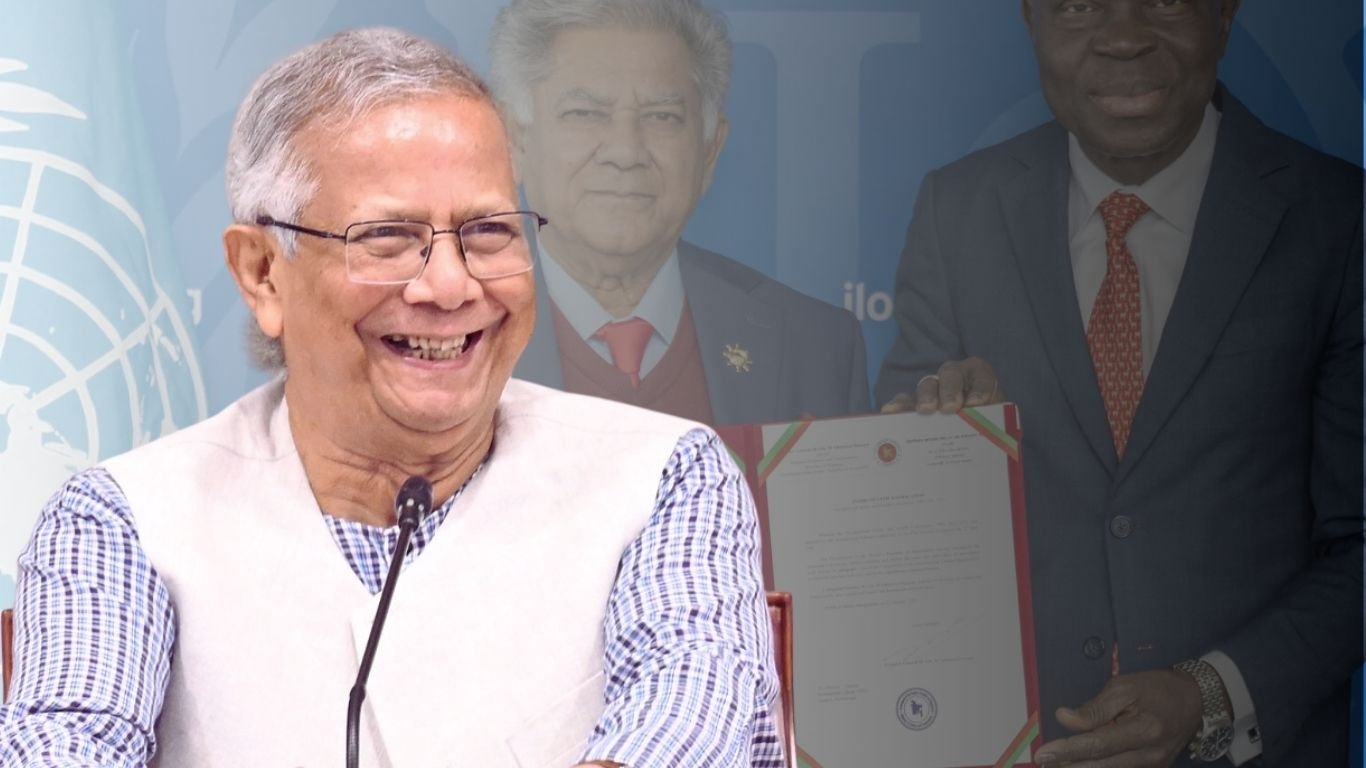
DSJ collage using images from CAO and ILO.
In 2025, Bangladesh adopted new labor policies to strengthen worker protections and align with international standards. It involved amending labor laws, ratifying all ILO conventions, introducing new social protection programs, and providing support to workers affected by layoffs and corporate failures.
Bangladesh becomes the second country in the Asia-Pacific region to ratify all International Labour Organization (ILO) fundamental Conventions, and the first country in South Asia to ratify Convention No.190. The changes include legal recognition, collective bargaining rules, wages, workplace safety, and social support systems.
On December 8, Brigadier General (Ret.) Dr. M Sakhawat Hussain, Labour and Employment Adviser, has credited the progress to effective tripartite cooperation among workers, employers, and the government. “This collaboration has elevated Bangladesh to new heights in labour rights, industrial harmony, and global acceptance,” he said. And, as of December, official statistics showed favorable results. Wage increases in the garment industry rose from 5 percent to 9 percent. The government updates minimum wages in 7 sectors, with plans to cover 21 more.
Labour and Employment Adviser reported key financial support measures, including BDT 575 crore (USD 47.25 million) in loan support for 31,669 Beximco Group workers, BDT 31.67 crore (USD 2.60 million) for 17,134 NASA Group staff, and BDT 80 crore (USD 6.57 million) from central funds for nearly 23,000 workers and their families. The EU also provided smaller amounts of money through programs for unemployment assistance and employment injury support.
The Adviser said, registering 347 new trade unions, withdrawing 44 political cases involving 48,000 workers, and removing 3,453 children from labor. The government conducted 11,691 inspections, established 347 daycare centers in garment factories for working mothers, and provided BDT 32.65 crore (USD 2.68 million) in maternity benefits to 1,270 women.
“The broader child labor rate (detrimental forms of work) remained relatively stable at 4.4 percent in 2022, up marginally from 4.3 percent in 2013, indicating that despite significant progress over the past two decades driven by increased school enrollment, Bangladesh is not on track to eliminate child labor by 2025.
Most working children remain in informal employment, often facing long hours and poor working conditions,” according to estimates released on June 12 by the ILO and UNICEF. While there has been a commendable decline in hazardous child labor, from 3.2 percent in 2013 to 2.7 percent in 2022 (representing about 1.07 million children), the overall proportion of working children (ages 5-17) slightly increased from 8.7 percent to 8.9 percent during the same period, they added.
The human cost behind the reform push: According to reports from the Human Rights Support Society (HRSS), a labor rights watchdog, over the past 44 months (from January 2022 to August 2025), at least 557 workers, both formal and informal, have lost their lives. More than 2,100 people have been injured from violence and exploitation in workplaces nationwide. In 2025 alone (from January to August), there were 66 reported deaths and 773 injuries resulting from violent incidents. A study conducted by the Bangladesh Institute of Labour Studies revealed that from 2018 to June 2025, 131 workers lost their lives and 578 others sustained injuries in 152 factory fires across the country.

Photo: DSJ Archive
Bangladesh has been an active Member State of the International Labour Organization (ILO) since June 22, 1972. In October 2025, the interim government ratified ILO Conventions No. 155 and No. 187 on occupational safety and health, and No. 190 on violence and harassment. The ILO will provide technical support for their implementation.
Professor Yunus, the savior of workers: Since the interim government ratified three conventions on October 22, Chief Adviser Professor Muhammad Yunus described the day as a memorable milestone in the realization of workers’ rights in Bangladesh. “This day will remain as a memorable one in the history of realizing the rights of working people in Bangladesh,” a Chief Adviser’s Press Wing press release quoted the Chief Adviser as saying in the ILO Convention signing ceremony.
It all began when the interim government formed the 10-member Labour Reform Commission on November 17, 2024, headed by Syed Sultan Uddin Ahmed, executive director of the Bangladesh Institute of Labour Studies (BILS). In a sweeping bid to bring justice to Bangladesh’s labour landscape, the Commission on April 22 this year submitted its report to the Chief Advisor, proposing comprehensive legal reforms to end the longstanding exclusion of informal, agricultural, and domestic workers from statutory protection.
The commission urged the government to implement necessary labor law reforms in Bangladesh to protect workers who have long been excluded, including those in garment factories, rice mills, domestic work, and delivery services. The report demands recognition of every worker’s right to decent pay, safe conditions, and a dignified life, regardless of their work setting.
“This report is not just about workers’ rights; it is about fulfilling the constitutional mandate to eliminate all forms of exploitation and uphold the dignity of the working people,” said Syed Sultan Uddin Ahmed, chair of the commission, during the formal submission of the report to the Chief Adviser.
What actually changed: The Bangladesh Labour (Amendment) Ordinance, 2025, was gazetted on November 17, introducing a raft of legal changes that broaden who counts as a “worker”, reduce union-formation thresholds, and add new protections such as an explicit ban on blocklisting.
Government communications list domestic and agricultural workers among those newly covered and extend maternity leave to 120 days. At a briefing at the Foreign Service Academy, Law Adviser Asif Nazrul said the amendments were designed “to bring the labour law in line with several conventions of the ILO.”
These steps are essential because they alter the legal framework, establish obligations for both employers and the state, and pave the way for technical and financial assistance from the ILO and international partners. However, these reforms are just the beginning.
Ratifying ILO Conventions No. 155 and 187 commits Bangladesh to international standards for occupational safety and health, requiring the government to develop national programs for prevention, monitoring, and training. This moves signals to global buyers and investors that Bangladesh aims to align its laws with international norms. This move is particularly significant for the garment sector.
At a press conference held at the National Press Club on October 23, the Workers’ Safety Forum, an alliance of labour and rights groups, demanded immediate government action on industrial safety, calling for a comprehensive investigation and justice for all accidents, and rejecting the nation’s history of “state failure” in protecting workers.
The government is demonstrating its commitment to institutional investment through several initiatives, including launching the National Occupational Health and Safety Research and Training Institute (NOSHTRI) in Rajshahi, establishing a new labor court in Mymensingh that has resolved over 13,000 cases, and planning a dedicated Department of Employment.
If adequately staffed and independent, these institutions could address enforcement gaps. The ILO is willing to provide technical support, and Bangladesh’s election as coordinator for the Asia-Pacific grouping (ASPAG) improves access to international expertise.

Photo: DSJ Archive
The arithmetic of informality: International and domestic labour data show why implementation is the real test. Large swathes of Bangladesh’s workforce remain informal; estimates put informal employment well above two-thirds of total employment, meaning many workers still lack formal contracts, social protection, or effective access to labour courts.
Fisheries and Livestock Adviser Farida Akhter said that although informal workers make up an overwhelming majority of Bangladesh’s labour force, most remain outside any form of legal recognition or protection. She made the remarks on December 9, while speaking as the chief guest at the “Informal-to-Formal Sector Women Workers’ Conference 2025.”
The adviser said that approximately 85 percent of the country’s workforce is engaged in the informal sector, leaving them excluded from most labour rights and social protections. She stressed that the economy would not function without the contributions of tea workers, fishers, and domestic workers.
However, she added, economists often focus only on the formal sector and overlook the role of informal workers. As a result, these workers’ economic contributions remain undocumented. Ensuring the rights of women workers, she said, is not only a matter of justice for them but also essential for the nation’s overall development.
She further said that discussions about workers almost always revolve around deprivation. “In reality, workers receive neither recognition nor rights. Despite the intensity of their labour and the exploitation they endure, they do not accept what is rightfully due to them,” Farida Akhter added.
Formal laws, informal lives: The ILO and other analysts have repeatedly emphasized that formalization is the key to converting legal reforms into lasting improvements in livelihoods. Registering new unions and creating childcare centers is essential. Still, it won’t protect homeworkers, smallholder agricultural workers, and informal service workers without proper documentation. Effective enforcement of the rules depends on adequate inspections and resources.
Bangladesh’s 2025 reforms are bold on paper. Together, they constitute a policy package, legal expansion, ratified conventions, social assistance, wage adjustments, and institutional creation that, if implemented sincerely, could improve safety, bargaining power, and social protection for millions of workers.
The ILO’s engagement and Bangladesh’s new institutional architecture give reason for cautious optimism. Still, the real test will be whether workers in factories, fields, and homes feel the difference at payday, when reporting abuses, or during a workplace health emergency.
Business backlash and labour’s divide: On October 28, 2025, BGMEA (Bangladesh Garment Manufacturers and Exporters Association) held a press conference urging the government to reconsider the newly drafted Bangladesh Labour (Amendment) Ordinance, 2025. The BGMEA argued that permitting unions to form with as few as 20 workers, rather than the previous 20 percent threshold, could destabilize factory management and disrupt labor-employer relations.
Mahmud Hasan Khan, BGMEA President, said, “If only 20 workers are allowed to form a union, individuals who are not directly involved in the industry may lead union activities, which will trigger internal conflict, instability, and disruption in production.” Shortly after the ordinance was gazetted on November 17, he rejected the law, stating that its adoption bypassed the consensus of the previous tripartite committee, and warned that the new rules (on union formation, provident fund, and expanded worker definition) threaten investor confidence and could negatively impact Bangladesh’s exports.
“That 20 workers can form a trade union is super disruptive in an industry that has all factory sizes,” Nazma Akter, president of Sammilito Garment Sramik Federation, said on November 19, after the ordinance gazette. Earlier, on October 23, just after the Advisory Council approved amendments, Kalpona Akter, Bangladesh Centre for Workers Solidarity (BCWS), said, “If monitoring is strong and both workers and employers understand the law equally, I don’t see any harm in allowing union formation with 20 workers.”

Photo: DSJ Archive
Growth, inequality, and the global context: According to World Employment and Social Outlook Trends 2025, there is a group of subregions and countries where a decline in spatial inequality corresponds to an increase in manufacturing; these include China, Bangladesh, Southeast Asia, Eastern Africa (except Ethiopia), and some francophone African countries.